
Z-Wave
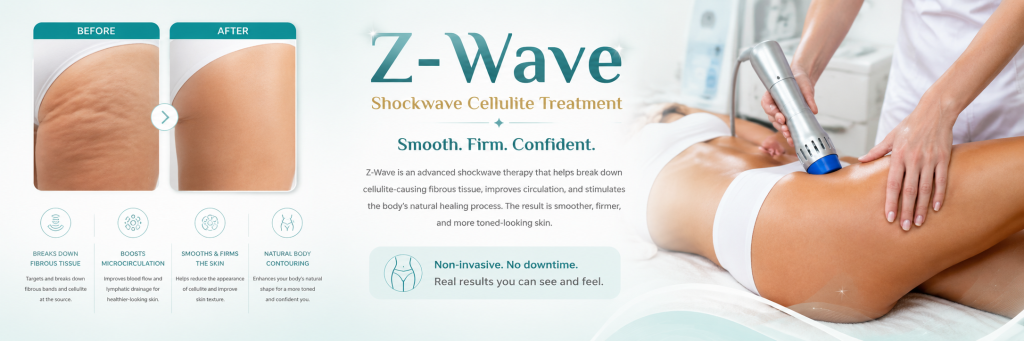
Shockwave Therapy for Cellulite, Localized Fat and Office Syndrome
Shockwave Therapy, also known as Extracorporeal Shockwave Therapy (ESWT), is a non-invasive treatment that uses mechanical acoustic energy to target specific areas of soft tissue.
Shockwave technology has been widely studied in musculoskeletal and soft-tissue conditions. It has also been investigated for aesthetic applications, particularly for improving the appearance of cellulite and uneven skin texture.
At Nicha Clinic, Shockwave Therapy may be incorporated into treatment programs designed to support body contouring, cellulite care, and the management of certain muscle-related pain conditions, including symptoms commonly associated with Office Syndrome.
What Is Shockwave Therapy?
Shockwave Therapy, or Extracorporeal Shockwave Therapy (ESWT), delivers mechanical acoustic waves through the skin into targeted tissues.
Unlike surgery or liposuction, Shockwave Therapy is performed externally and does not require surgical incisions.
In medical practice, shockwave therapy has been studied extensively for various musculoskeletal and soft-tissue conditions, including Myofascial Pain Syndrome, tendon-related disorders, and other chronic pain conditions.
Can Shockwave Therapy Help With Fat and Cellulite?
Shockwave Therapy has also been studied as a non-invasive approach for improving the appearance of cellulite.
Research suggests that mechanical shockwaves may influence the subcutaneous tissue and the structure of connective tissue beneath the skin, potentially improving the appearance and texture of cellulite in some patients.
However, Shockwave Therapy should not be described as a direct weight-loss treatment or as a method that completely eliminates body fat.
A more accurate description is that Shockwave may be used to support the management of localized areas of cellulite, uneven skin texture, and certain body-contouring concerns, depending on the individual and the treatment protocol.
It may be considered for people who want to improve:
- Cellulite or “orange-peel” skin
- The appearance of localized areas of fat
- Uneven skin texture
- The appearance of the thighs, hips, or abdomen
- Body contouring without surgery
- Cellulite care as part of a combined body-contouring program
Important: Shockwave Therapy is not a treatment for obesity and should not replace a healthy diet, regular physical activity, or medically indicated weight-management treatment.
Shockwave Therapy for Office Syndrome
Office Syndrome commonly refers to musculoskeletal symptoms associated with prolonged sitting, computer work, smartphone use, repetitive movements, or poor posture.
Common symptoms include:
- Neck pain
- Shoulder pain
- Upper back pain
- Tightness around the shoulder blades
- Muscle stiffness
- Trigger points or localized tenderness
- Pain caused by repetitive muscle use
Shockwave Therapy may be used as part of a treatment approach for certain muscle-related pain conditions, particularly Myofascial Pain Syndrome.
Clinical studies have reported potential benefits of ESWT for reducing pain and improving function in some patients with myofascial pain.
However, neck, shoulder, and back pain can have many different causes. A proper assessment is important to determine whether the symptoms are primarily muscular or related to another underlying condition.
How Does Shockwave Therapy Work?
During treatment, the applicator delivers mechanical acoustic energy through the skin into the targeted tissue.
The mechanical stimulation produced by shockwaves may influence several biological responses within the treated tissue. Research has investigated effects related to pain modulation, tissue response, and local healing processes.
For muscle-related conditions, the goal is not simply to “massage” the muscle. Instead, Shockwave Therapy uses mechanical energy to stimulate the targeted tissue.
What Happens During a Shockwave Treatment?
1. Initial Assessment
The treatment area and the patient's main concern are assessed, whether the goal is cellulite care, localized body contouring, or muscle-related pain.
2. Treatment Area Identification
The practitioner identifies the appropriate target area for shockwave application.
3. Shockwave Application
The applicator is placed against the skin and mechanical acoustic waves are delivered to the targeted tissue.
4. Energy Adjustment
The energy level and treatment parameters are adjusted according to the treatment area, clinical objective, and individual response.
5. Follow-Up Assessment
The patient's response is evaluated to determine whether further sessions or additional treatment approaches may be appropriate.
Does Shockwave Therapy Hurt?
Patients may feel rhythmic tapping, pressure, or mechanical pulses during treatment.
The sensation varies depending on the treatment area, energy level, and individual sensitivity.
Areas that are already tight or tender may feel more sensitive during treatment.
The treatment intensity can generally be adjusted according to the patient's tolerance and the treatment objective.
How Many Shockwave Sessions Are Needed?
There is no single treatment schedule that is appropriate for everyone.
The number of sessions depends on the treatment goal, the type of shockwave used, the treatment area, and the individual's response.
Some clinical studies investigating cellulite have used approximately 6–8 treatment sessions, once or twice per week. However, research protocols should not be interpreted as a universal treatment schedule for every patient.
For muscle-related pain, the appropriate treatment plan should be determined based on an individual assessment.
Who May Benefit From Shockwave Therapy?
Shockwave Therapy may be considered for people seeking support for:
Body Contouring and Cellulite
- Cellulite
- Uneven skin texture
- Localized body-contouring concerns
- The appearance of orange-peel skin
Muscle and Pain Management
- Neck pain
- Shoulder pain
- Upper back pain
- Muscle tightness
- Myofascial Pain Syndrome
- Muscle-related discomfort associated with repetitive use
A professional assessment is recommended to determine whether Shockwave Therapy is appropriate for your specific condition.
Shockwave Therapy at Nicha Clinic
At Nicha Clinic, every Shockwave treatment begins with an assessment of the individual's concerns and treatment goals.
Shockwave Therapy may be incorporated into personalized programs for cellulite care, localized body-contouring concerns, and certain muscle-related pain conditions involving the neck, shoulders, upper back, and other areas.
If you are looking for Shockwave Therapy for Office Syndrome, muscle pain, cellulite, or localized body-contouring concerns, our team can assess your condition and recommend an appropriate treatment approach based on your individual needs.
Book a consultation with Nicha Clinic to find out whether Shockwave Therapy is right for you.